 |
|
HOME TURTLE BOA DEGUS RAT DOG HUMANS 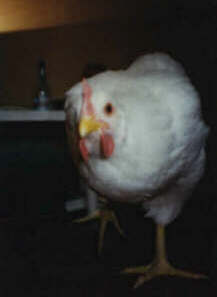
--> PICTURES
CLASSIFICATION
phylum : chordata class : aves order : galliformes family : phasianidae subspecies : gallus g. domesticus NATURAL HISTORY origin : birds appeared 140 million years ago ; domestic fowl comes from China and oriental Asia. geographic distribution : the common ancestor of domestic hens is gallus bankiva that always lives in the asiatic jungle ; domestic fowl has been introduced in Europe during Middle Ages. BIOLOGY weight : average of 2kg longevity : 12 years sexual maturity : from 6 months to 6 years old incubating time : 20-22 days number of eggs /year : 100-300 (depends of genera) corporal temperature : 42°C hens are diurnal and gregarious animals senses eyesight : + + + hearing : + + taste : + + smell : - BEHAVIOR Social organization In a poultry-yard hens use a strict dominant/submissive schema for access to food, perch, sexual partners ; usually the dominant hierarchy is a linear one : it consists of an A animal which dominates all the others, a B animal which dominates every animals except A, etc. Hierarchy formation A canandian study has examined the role of observation during the formation of triads in female domestic hens. Results indicate that during hierarchy formation, a hen observing agonistic interactions and conflict settlement between its former dominant and a stranger, uses this information when in turn confronted by the latter. The behavioural strategies of bystanders depended on the issue of the conflict they had witnessed. When bystanders had witnessed the domination of their prior dominant by a stranger, they behaved as having no chance of defeating the stranger. On the contrary, when bystanders had witnessed their prior dominant defeating the stranger, they behaved as having some chances against the stranger. These results highly suggest that bystanders gained some information on the relationship existing between their prior dominant and the stranger and that they used it coherently, perhaps through transitive inference, thus contributing to the existence of transitive relationships within the triads. FEEDING cereals (wheat, corn...) but also grass, insects, small pebbles (which are used in gizzard to mill food) food consumption : about 70g/kg/day water consumption : about 5ml/kg/day HOUSING at large : hens always sleep in the same place if it's a cool place : no wind, no rain, quiet and with a high perch. in a hen-house : animals must be protected of wind and rain ; minimum size : 1m² for 2 hens. installations : perches, nests (steady boxes with straw or hay), watering-places. DISEASES symptoms of an ill bird : anorexia, feathers fall, excess sleep, ruffled bird, apathy, weight loss. infectious illnesses can be transmitted by a new animal in the group or by the droppings of wild birds. endoparasites : slugs, earthworms and insects are carriers of endoparasites. --> the most frequent parasites are : Dermanyssus gallinae, Menacanthus stramineus... (see the links) POUIC-POUIC She was born in a farm and has arrived at home when she was 15 days old. First she was in a hen-house (in a room of our house cause it was winter), but most of time she was with us in the living room ; so we began to become her group and she acquired a total trust in us, behaving almost as a dog (begging for food in scraping our thighs when we are eating, running in the kitchen when she hears the noise of plates, perching besides us on the sofa...) ; now she is used to the garden, which is very large but she seems to prefer the house ! This gentle hen weighs 3,5 kg and gives us about 125 eggs/years ; she is very sociable, she comes very well when she hears her name and loves to sleek her feathers in front of mirrors. She has showed us that she is able to understand objects disappearances (ex : a piece of cheese is showed to her and hid behind my back : she turns around me to take it !)... well, we think that hens are not so stupid they seem to be ! LINKS hierarchy formation in hens : http://cogprints.org/1960/ Parasites : http://icb.usp.br/~marcelcp/Default.htm |